We don’t go to church,
we make it.
Celebrating and gathering at All Saints is an act of communal, participatory fellowship. Nothing to be scared of, just very different from the way many of us have experienced in the past.
As you walk in, you may see attendees deciding to add an extra table two minutes before service. One congregant lights a set of candles, while someone else is by the piano helping the priest find the best spot for the eucharistic bread and wine.
We show up never knowing quite who else will, too, or what will happen, and we take it as it comes.
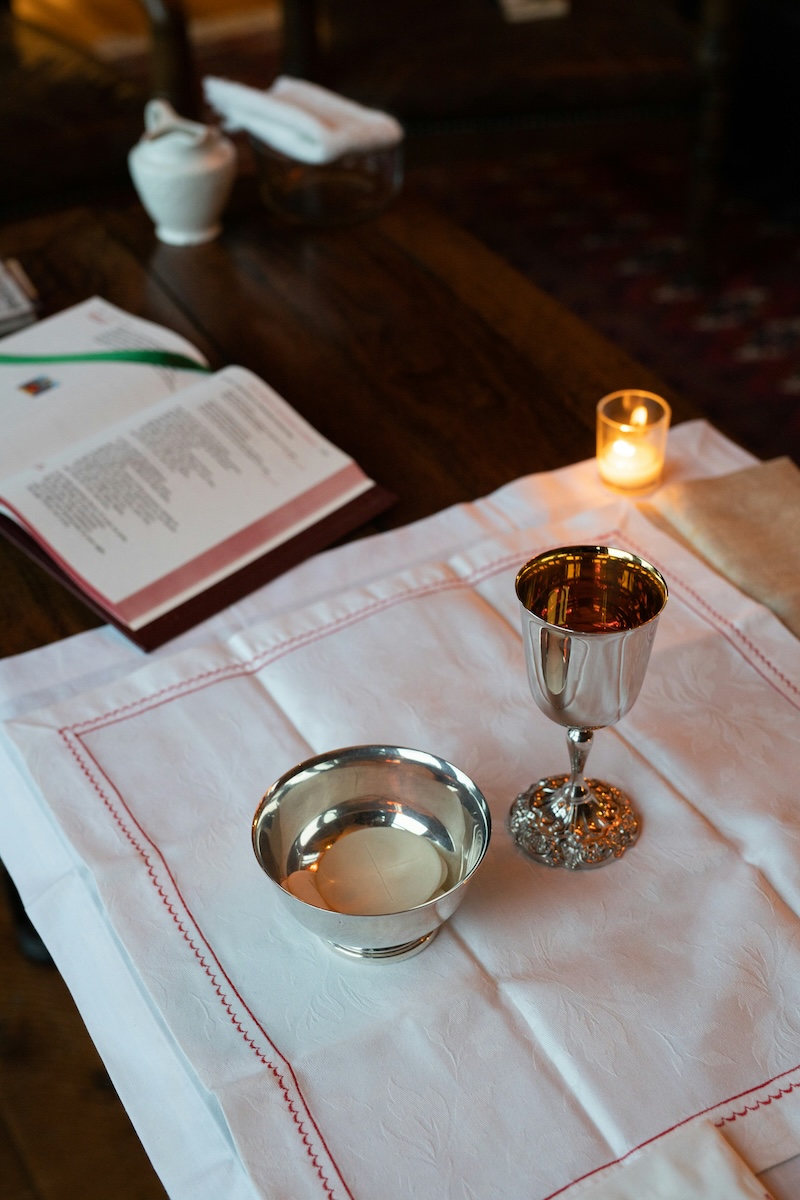
We worship around the table, and then we eat.
There’s something special about worshiping around a table. It allows us to connect, with words or in silence, to gaze around the room to acknowledge who is present, and to rest our hands on a shared surface. Having a literal place at the table during service, for many of us, is to assume ownership of narratives and rituals that may not always have been welcome to us.
We’re not big fans of single-use appliances, and so the table at which we share spiritual food transforms into a dinner table in a matter of minutes. Everyone who has been to All Saints once or twice knows that we do a darn good potluck, and is happy to contribute what they can. Over food, conversations flourish, bridges are built, humans meet humans.
Bring a vegetarian dish if you’re able. Homemade, store-bought, or home-delivered, as you please.


We cherish the rhythm of Anglican liturgy
Whatever we come to experience together, our liturgy is always at the centre. As an Episcopal church (learn more about what that means), we honour the rhythms of the Daily Office, and use the Book of Common Prayer to design our services.
Morning and evening prayer
We frequently gather in person and online to engage in morning or evening prayer. It’s a centuries old tradition carried out by people all over the world. Once you’ve done it a few times, you’ll see that the framework is always the same, and the Psalms, Old Testament passages, and the Gospel change every day. Praying our way into the day or out of its busyness is a way to recentre, to remember we’re students of Jesus, and to reflect on how we walk our talk.


The Holy Eucharist
“Eucharist” means thanksgiving in Greek. When we gather to receive the it, we pray, sing, and listen our way through a dynamic service. There are shared prayers, like the Our Father, a sermon by a priest, as well as hymns and modern-day worship music, and various readings from the Bible.
The service culminates in the priest giving the first person to their left or right a piece of bread and a sip of wine. “Do this in remembrance of me”, Jesus said. And we do. We then “communicate” each other: pass around the plate of bread and cup, to remind ourselves and each other why we gather in church.